


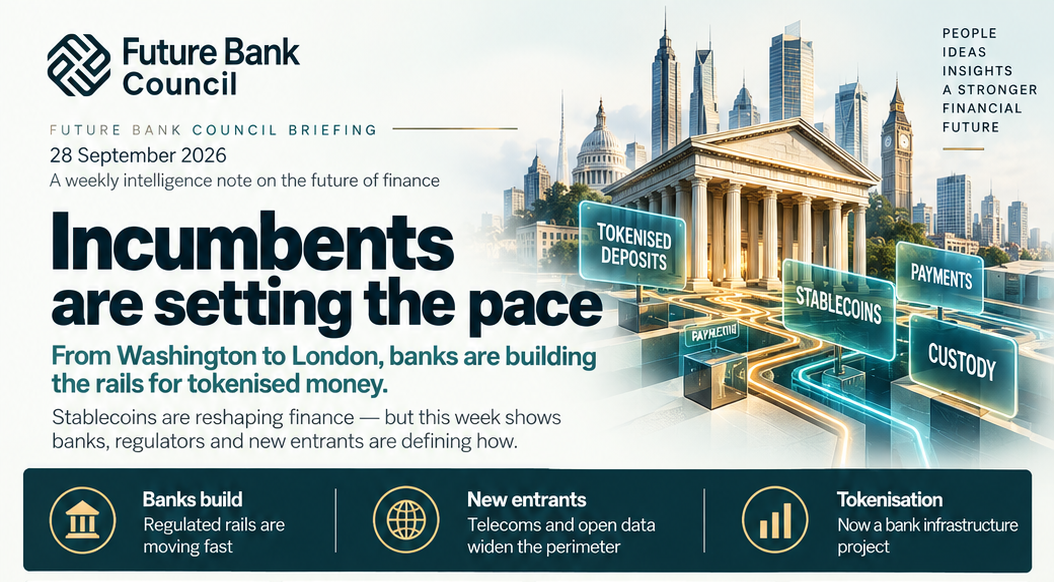

Banks build the rails stablecoins were meant to replace
- Washington, Ottawa and London are wiring bank-owned rails to match stablecoin speed.
- Dhaka and Nairobi show the perimeter opening to telecoms and data-sharing mandates instead.
- Tokenisation is now a bank infrastructure project, not only a crypto-industry pitch.
Top stories
1. The Fed sets the terms banks must meet to issue stablecoins
North America | 24 September 2026
A narrow, bank-only path into stablecoins
The Federal Reserve Board proposed two rules on 24 September implementing the Guiding and Establishing National Innovation for U.S. Stablecoins Act (the GENIUS Act). One sets reserve and capital standards for Board-supervised issuers, and the other creates an approval process for banks.
Reserves, capital and a governor's reservations
Issuers must hold reserves in Treasury bills and similar liquid assets, with new capital charges for credit and operational risk. Governor Michael S. Barr said stablecoins "will only be stable if they can be reliably and promptly redeemed at par in a range of conditions." He welcomed those provisions but flagged one risk. A "significant or systemic" threshold in the anti-money laundering language, he warned, could limit supervisors' power to enforce compliance.
A template every other regulator will be read against
Every other stablecoin story this week, from Ottawa to Dhaka, will be measured against this template. Banks that meet its reserve and capital bar gain a compliant route into a market stablecoins built outside banking.
Where this leads: Expect balance-sheet-rich banks to dominate compliant stablecoin issuance within three to five years, leaving non-bank issuers to compete on narrower terrain regulators watch more closely.
2. Canada's Big Six banks agree to explore shared tokenised deposits
North America | 22 September 2026
Six rivals choose to build together, not separately
Canada's Big Six banks said on 22 September they will jointly explore shared tokenised Canadian dollar deposits. The first phase will move tokenised deposits between the six banks, with other deposit-takers invited to join later.
A shared ledger where competitors usually build alone
The founding participants are Bank of Montreal, the Canadian Imperial Bank of Commerce and National Bank of Canada. Royal Bank of Canada, Scotiabank and TD Bank Group complete the group, according to TD's own announcement of the initiative. It follows Export Development Canada's tokenised bond issued in March under Project Samara, worth 100 million Canadian dollars (about $71 million). No individual executive was named in the banks' joint statement.
Cooperation now looks cheaper than a fragmented rebuild later
Six competing lenders rarely choose shared infrastructure over proprietary systems. Building one interoperable ledger together lets Canadian banks match tokenised-deposit models already live in the UK, without each bank duplicating the engineering cost alone.
3. UK banks move tokenised deposits from pilot into live payments
Europe | 24 September 2026
Real transactions, not another sandbox exercise
Seven UK banks, including Barclays, HSBC UK, Lloyds, NatWest and Santander, completed the first live customer transactions using tokenised sterling deposits, according to UK Finance. The trial, under the Great British Tokenised Deposit initiative, included two remortgage completions with automatic fund release and a marketplace transaction with conditional payment.
Programmable money moves from theory to mortgages
Jana Mackintosh, managing director of payments and innovation at UK Finance, said the transactions "show how tokenised deposits can deliver practical benefits and contingent payments." Ryan Hayward, Barclays' managing director for digital assets, said moving "from testing into live transactions shows how tokenised deposits could help make payments more efficient."
Deposits, not stablecoins, are Britain's chosen vehicle
The Bank of England has signalled a preference for tokenised deposits over stablecoins as the route to faster settlement. This pilot is the clearest evidence yet that large UK banks share that preference. A governing company and three digital bonds are due in the first quarter of 2027, extending the model from payments into securities settlement.
4. SoFi and Mastercard put a bank-issued stablecoin on card rails
North America | 22 September 2026
An entire card programme migrates to blockchain settlement
SoFi and Mastercard said stablecoin settlement is live across SoFi Bank's debit and credit card programme, covering an estimated 25 billion dollars in annualised volume. The settlement currency is SoFiUSD, a stablecoin issued by SoFi Bank, a national bank regulated by the Office of the Comptroller of the Currency (OCC).
A bank-chartered stablecoin, deliberately
SoFi chief executive Anthony Noto said the companies took stablecoin settlement "from an idea to a live product" within six months. Mastercard's Sherri Haymond, global head of digital commercialisation, said stablecoins "become meaningful when they solve real problems that businesses face every day." SoFiUSD is redeemable one to one for dollars against cash reserves, according to the companies.
The card networks are hedging their own disintermediation
By settling through a bank-issued coin on its own rails, Mastercard keeps card networks relevant even if stablecoins displace parts of traditional settlement. SoFi, in turn, uses its national charter as the point of difference against non-bank stablecoin issuers competing for the same merchants.
5. A telecoms group wins a full banking licence in Bangladesh
South Asia | 25 September 2026
From payments to a full deposit-taking licence
Bangladesh Bank approved a digital bank licence for a joint venture between VEON Digital Financial Group and Square Group. It extends beyond the payment provider licence VEON's Banglalink unit already holds for Mukto Pay.
A charter built on top of an investment and a telecoms base
VEON has committed 250 million dollars as anchor investment, part of a targeted 1 billion dollars in foreign direct investment. VEON group chief executive Kaan Terzioglu said "financial inclusion is key to eradicating poverty, and today's approval marks an important step toward that goal." Banglalink chief executive Johan Buse said the venture is positioned to serve Bangladeshis "who have lacked access to conventional banking."
Telecoms distribution, not core banking technology, is the scarce asset
A telecoms group, not a domestic bank or a global platform, has become the vehicle for full-scale digital banking in Bangladesh. Much of the country's population remains unbanked, and Banglalink already owns the customer relationship and distribution network banks would otherwise have to build.
6. Deutsche Bank prepares to custody the assets it once shunned
Europe | 16 September 2026
A regulated custody service for bitcoin, ether and stablecoins
Deutsche Bank said it plans to launch a regulated digital asset custody service for European institutional and corporate clients. It will cover bitcoin, ether and several dollar and euro-denominated stablecoins, with tokenised financial instruments planned to follow.
Complement, not replacement, is the bank's chosen framing
Client onboarding is expected once regulatory approval is granted. Gerald Podobnik, co-head of Deutsche Bank's corporate bank, said digital assets "complement traditional finance rather than replace it," benefiting from the safeguards of regulated institutions. The service will sit inside the bank's corporate and investment bank divisions, targeting asset managers, hedge funds, custodians, brokers and sovereign clients.
Custody is the least disruptive way in
By entering through custody rather than issuance, Deutsche Bank captures institutional demand for digital assets. It avoids the redemption and reserve risk regulators are now writing rules for elsewhere this week.
7. Europe and Brazil study linking their instant payment systems
Europe/Latin America | 24 September 2026
A feasibility study, not yet a live corridor
The European Central Bank's Governing Council approved a feasibility study linking its TARGET Instant Payment Settlement system (TIPS) with Pix, Brazil's instant payment system. Brazil's central bank co-sponsored the study, which covers technical, legal and business questions with no live-service timeline set.
A quiet announcement by the standards of this week
Pix processes roughly 250 million payments a day, settled in central bank money. Neither institution named an individual spokesperson for this announcement, an omission worth noting given how much of this week's other news carried named voices. The study sits alongside the Eurosystem's other cross-border work, including links explored with India's payments interface and Switzerland's instant clearing system.
Public infrastructure is quietly becoming the cross-border answer
If TIPS and Pix connect, remittances and trade payments between the euro area and Brazil could settle in seconds through central-bank rails. No stablecoin or correspondent bank would sit in between, a direct alternative to the private tokenised networks banks are separately building.
8. Kenya moves to force banks and M-Pesa to share customer data
Africa | 22 September 2026
Open finance, not only fintech licensing
Kenya's central bank and National Treasury published a draft National Payment System Bill on 22 September. It would require banks, M-Pesa and other payment providers to share customer transaction data with licensed third parties on consent.
Capital floors alongside the data mandate
The bill would replace the 2011 National Payment System Act, with public comment running to 9 October. It sets minimum capital of roughly KES 250 million (about $1.9 million) for electronic money issuers such as M-Pesa. Smaller payment service providers would need roughly KES 5 million (about $39,000), based on current exchange rates. It also raises the Central Bank of Kenya's enforcement powers, with fines of up to roughly KES 30 million (about $231,000). No individual official was quoted in the documents reviewed.
A market where mobile money already dominates now gets forced interoperability
Kenya's mobile money market is unusually concentrated, which makes a mandatory data-sharing regime more consequential than similar open banking rules elsewhere. Incumbent banks and M-Pesa lose some of the data advantage that built their dominance. Smaller payment firms gain a route to compete on services rather than infrastructure.
Our view
We think banks are winning the argument that regulated money, not privately issued stablecoins, should carry the tokenised economy forward. They are winning it, though, by conceding exactly the openness they spent a decade resisting. The Federal Reserve, Canada's Big Six banks and Deutsche Bank are choosing to build or licence the infrastructure stablecoin issuers hoped would make them irrelevant. That is a defensive win dressed as innovation, and it works only if banks can move as fast as the non-bank platforms did.
The Bangladesh and Kenya stories show the limits of that defence. A telecoms group can assemble distribution faster than a bank can build trust in a new payment rail. A regulator can also simply mandate data-sharing, and incumbency stops being a reliable moat. We expect the next twelve months to separate banks that treat tokenisation as core infrastructure from those still treating it as a side project. That gap should widen faster than most boards currently assume.
The unresolved question is enforcement. Barr's own reservations about the anti-money laundering threshold, and the unnamed voices behind the ECB-Brazil study and the Canadian banks' joint statement, point to the same gap. Ambition is outrunning supervisory capacity to police these announcements at scale.
Whoever controls the rails, not whoever issues the token, will decide who intermediates money next.
Russell P,
TAB Global


Banner.png)



.png)






 Google
  LinkedIn