




Trade finance is moving into a new infrastructure phase. Banks are no longer treating digitalisation simply as a way to replace paper forms with online applications. Across the 2026 trade and supply chain finance submissions, a significant theme is the development of digital environments in which trade documents, transaction data, compliance checks, financing decisions and supply-chain information can move between participants through connected systems.
This matters because the document is still at the centre of many trade transactions. Letters of credit, guarantees, invoices, bills of lading and supporting records carry the information needed to establish an obligation, release financing or complete settlement. Digitising the document therefore has a wider consequence than improving the user interface. It can change how information is created, verified, transferred and acted upon across the trade chain. Moreover, the development of legal frameworks recognising electronic transferable records, including jurisdictions enacting legislation based on or influenced by the UNCITRAL Model Law on Electronic Transferable Records (MLETR), provides an important foundation for this transition.
The TABInsights Trade and Supply Chain Finance 2026 analysis covers 15 valid trade and supply chain finance submissions from global, regional and domestic banks across Asia Pacific. The percentages indicate the share of submissions in which a theme or practice appeared, rather than a statistically representative measure of corporate adoption.
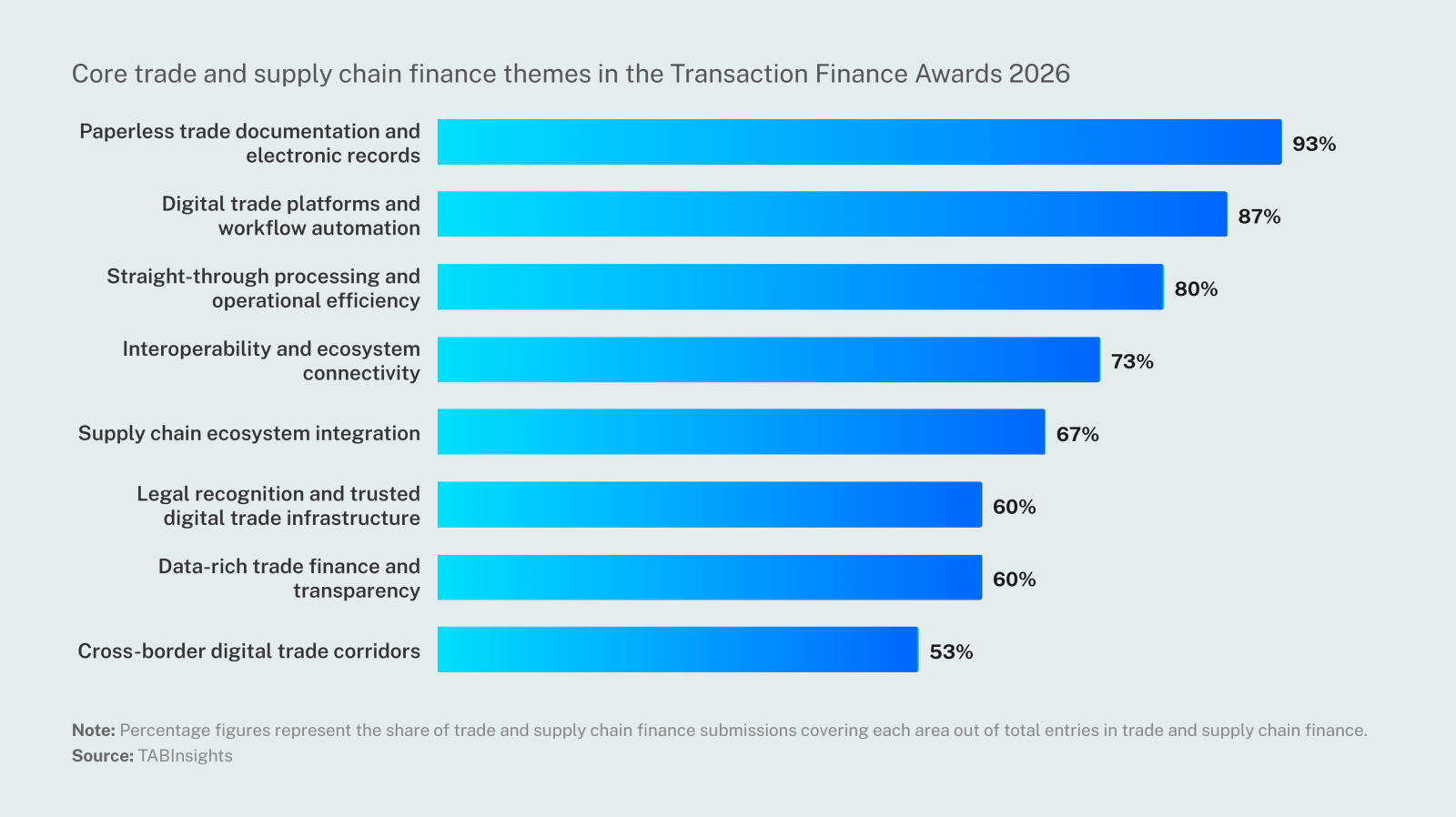
The strongest signal is the prevalence of paperless documentation and electronic trade records, identified in 93% of submissions analysed. Digital trade platforms and workflow automation appeared in 87%, while straight-through processing and operational efficiency were identified in 80%. Interoperability and ecosystem connectivity appeared in 73% of submissions. These submissions suggest that leading banks are investing in digital trade models built around the exchange and processing of information alongside traditional document flows.
For banks, therefore, the competitive question is shifting from who offers the most advanced trade portal toward who can connect more of the trade lifecycle, while preserving data integrity, legal certainty, compliance and operational control.
Banks identify paperless documentation and connectivity as leading themes in the transition toward digital trade infrastructure
The distinction between digitising a document and creating a digital trade record is important. A scanned invoice or PDF uploaded to a bank portal reduces physical handling, but the underlying process can remain document-heavy if employees still need to inspect, re-key or reconcile information manually. A more mature model turns documentation into structured information that can be validated, exchanged and used by other systems.
Kotak Mahindra Bank provides one of the clearest examples. Its Paperless Trade proposition covers import, export and electronic bank guarantees, with the bank describing a workflow in which document submission, processing, approval, scrutiny and archival are performed digitally. It reported that routine trade turnaround times fell from T+1 to two to three hours, while physical documentation was eliminated from the relevant processes. Its Trade Application Programming Interface (API) Stack goes further by allowing Enterprise Resource Planning (ERP) systems to send trade instructions directly to the bank and receive processing outcomes through reverse feeds, creating bidirectional data exchange rather than requiring users to re-enter information through a portal.
The implications extend beyond the bank-corporate relationship. Deutsche Bank describes this as “moving paper across the trade ecosystem”, including a proof of verification with other financial institutions to test electronic exchange of trade documents through Swift FileAct. It also worked with fintechs and Swift on market-standard APIs for trade finance.
Digital trade requires common standards across institutions. Interoperability becomes a requirement if an electronic record is to retain value as it moves between banks, corporates and other participants across the ecosystem.
From electronic documents to interoperable trade records
This is where the next stage of trade digitalisation becomes more demanding. Individual banks can digitise their own processes relatively quickly, but trade transactions rarely remain within one institution. A corporation may originate an instruction in an ERP system, a supplier may provide an invoice through another platform, a bank may perform compliance checks, another institution may finance or confirm the transaction, and a logistics or customs system may hold information relevant to the underlying trade.
The 2026 trade finance submissions increasingly show banks addressing this fragmentation through connectivity rather than building isolated digital channels. The challenge is not only converting documents into electronic formats. Trade instruments derive value from trust, control and legal recognition. Digital infrastructure must therefore establish who controls a record, how transfers are recorded and how participants can rely on its authenticity.
Bank of China Hong Kong (BOCHK), for example, describes the use of Port Community System logistics and customs data to support trade-finance applications. With customer consent, the bank uses real-time data from logistics and customs systems to assess business status and detect potential fraud without repeatedly requesting supporting documents. It also describes BOC DataPLUS, through which customers can provide invoices and proof of delivery in data format for import invoice financing. Its broader digital trade environment combines third-party platforms with internet banking, host-to-host and API channels.
CTBC Bank provides another example through electronic bills of lading. Its participation in Bolero and essDOCS enables customers to issue electronic bills of lading and present related documents through digital platforms. The bank has expanded the digital model beyond letters of credit to import and export bills collection and to overseas branches in Hong Kong and Southeast Asia. Separately, its SCF platform allows buyers to transmit accounts-payable information through internet banking or a blockchain-based platform, providing the data required for supplier financing without relying on the same paper-based process.
These examples illustrate an important change in the role of the bank. The bank is increasingly becoming one connected participant within a broader digital trade environment, while retaining its role in authentication, compliance, financing and risk management.
However, digitising the record alone does not create value unless the information can be consumed by downstream processes. This is where automation becomes the next layer of the infrastructure.
Automation becomes the operating layer for digital documentation
Figure 2 shows that the leading practices are concentrated around the new infrastructure. Digitising trade documents and processes was evidenced in 93% of submissions analysed, followed by automated trade finance workflows in 80% and API or platform connectivity in 73%.
The pattern suggests that automation is becoming the layer that allows digital documentation to create operational value. Once information is captured in structured form, banks can use it for validation, reconciliation, credit assessment and compliance without repeating the same manual checks.
Deutsche Bank describes intelligent document recognition that extracts, classifies and converts information from documents into data. The resulting data can support compliance analytics, including automated entity recognition and transaction due diligence. This creates a progression from document digitisation to data processing: the document is no longer simply stored electronically but becomes an input into downstream controls.
Kotak similarly embeds regulatory validations, structured compliance checklists and rule-based controls into trade initiation. Its submission describes the use of structured data capture to reduce discrepancies and improve first-time-right processing. Its EwayGo platform for digitalising invoice financing and supply chain finance also uses data retrieved from invoices and electronic waybills to support financing decisions and automated compliance checks.
China Merchants Bank’s digital guarantee programme illustrates the same principle in a different trade instrument. Its “Guarantee Manager” integrates optical character recognition, data analysis, artificial intelligence and blockchain-based evidence storage. It also supports online verification of guarantees through data exchange between banks, while linking guarantee issuance and management with electronic corporate records. The objective is not simply to put a guarantee online but to make the instrument easier to authenticate, manage and use in subsequent processes.
Infrastructure must support the entire supply chain
Digital documentation also changes the economics of SCF. The relevance for SCF is that digital records can provide more timely evidence of commercial activity, allowing financing decisions to be connected more closely to underlying transactions.
United Overseas Bank’s submission describes digital documentation, real-time tracking and digital financing requests across its financial supply chain management platform. It reports that these capabilities have reduced reliance on paper-based workflows and enabled financing, documentation and approvals to operate through common workflows across ASEAN and Greater China. Its H2H integration with Infinity FSCM, its digital trade and SCF platform, has also been used to automate invoice ingestion and straight-through processing.
Ping An Bank takes a broader ecosystem approach. Its “1+N+n” model extends from a core enterprise to larger suppliers and distributors and then to longer-tail participants. The bank describes combining transaction information, asset information and corporate credit within a digital risk framework, while its platform supports online, model-driven and automated supply chain finance processes.
The common feature is that digitalisation is extending beyond the bank’s internal workflow. It is becoming a mechanism for connecting the commercial event, the supporting record and the financing decision.
From portals to shared trade infrastructure
Other submissions reinforce the regional dimension of this shift. MUFG describes linking its own infrastructure with partner banks so that trade activity can be managed through a more consistent regional structure. Its trade solutions increasingly cover multiple tiers of a supply chain, including distributor finance, supplier finance and pooled receivables purchases.
ICBC’s submission describes a move toward fully online trade finance, integrated domestic and overseas banking systems and embedded risk controls, with technology used for real-time monitoring and compliance across the trade lifecycle.
The evidence points toward a gradual change in what “digital trade” means. The first stage was putting applications online. The next is connecting bank systems to corporate platforms. The more consequential stage is creating trusted digital records that can move between participants and remain usable for verification, compliance, financing and settlement.
The next stage will focus on interoperability
The 2026 trade and SCF submissions indicate that the trade finance industry has moved beyond the question of whether paper can be removed from individual processes. The more difficult question is whether the resulting digital records can move seamlessly across institutions, jurisdictions and commercial systems without losing their integrity or requiring manual intervention.
That distinction will become increasingly important as electronic records and transferable instruments gain greater legal recognition. A paperless process that still depends on PDFs, manual verification and bilateral workarounds may reduce operating costs, but it does not fundamentally change the infrastructure of trade. Digitalisation therefore shifts the challenge from document handling to infrastructure coordination.
The stronger examples in the submissions point toward a different model: structured data, electronic records, digital signatures and verification, API connectivity, automated controls and interoperable platforms operating together. BOCHK’s use of logistics and customs data, CTBC’s electronic bill-of-lading connectivity, Deutsche Bank’s work on electronic document exchange, and Kotak’s ERP-linked trade workflows illustrate different parts of that emerging architecture.
The submissions indicate that many banks are investing in the operational foundations required for that model. However, the next stage will depend on whether these capabilities can connect beyond individual bank ecosystems through common standards, legal recognition, corporate systems and trusted digital records to support genuinely interoperable, paperless trade.
Subscribe for regular insights.


Banner.png)


.png)





 Google
  LinkedIn